
When you set up a webshop, the easy choice is whatever payment option comes built in. For most shops that works fine. For pharmacies, supplement brands and CBD sellers, it's often where the problems start.
Here's what the big mainstream providers say about health products, in plain language, and what to do if yours aren't covered.
Policies change. Everything below reflects each provider's published rules as of September 2026. Always check their current list before you sign up.
Stripe
Stripe is popular, easy to set up, and used by millions of businesses. It's also strict about health products:
- Prescription medicines: Stripe says payments for prescription medication generally need to happen outside its platform.
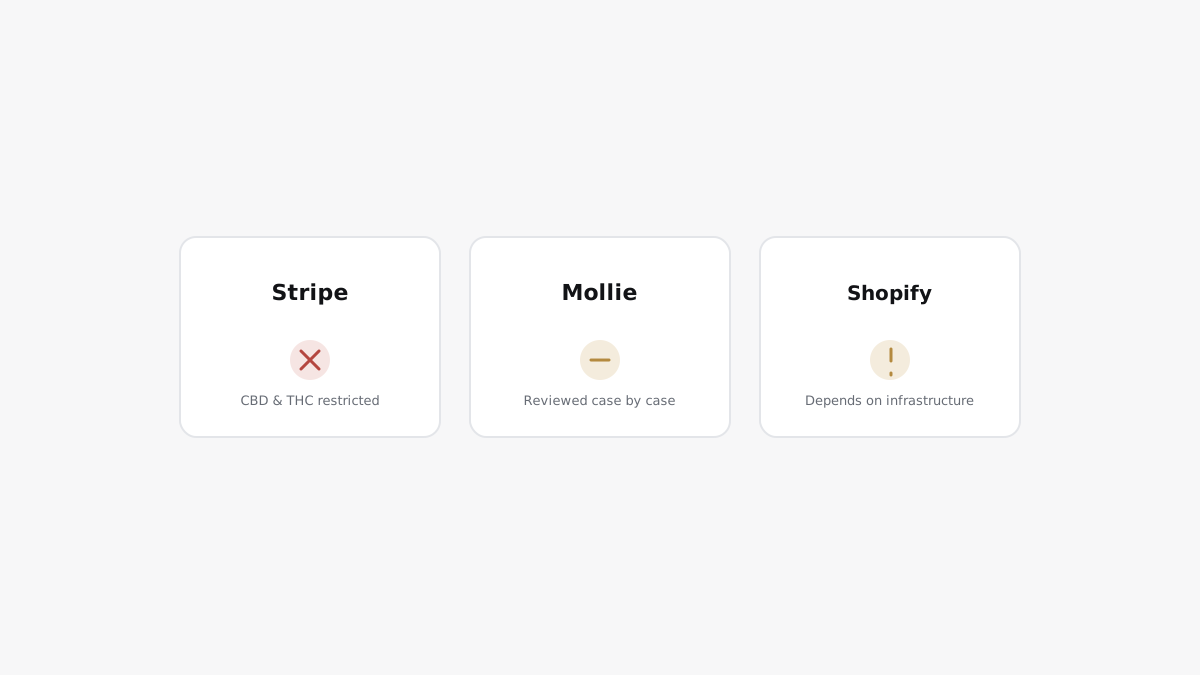
- CBD and THC: Stripe currently restricts any products that contain CBD or THC, including oils, tinctures and topical creams, even where they're legal.
- Supplements: Stripe prohibits nutraceuticals and pseudo-pharmaceuticals that aren't safe or make harmful claims.
What this means for you: a simple vitamin shop with careful wording may be fine. But the supplement rule is open to interpretation, and automated reviews tend to be cautious. If supplements are your core business, you're building on uncertain ground.
One useful detail: if you sell a mix of products, Stripe says you can keep processing the non-CBD ones. That can help a general shop, but it means running a second payment route for the rest anyway.
Mollie
Mollie is a Dutch provider popular with European small businesses. Its list of products it won't accept includes:
- Unlicensed trade in prescription medicines, pharmaceutical services or controlled substances
- Pseudo-medication or pseudo-pharmaceuticals
- Narcotics or drugs, and materials that can be used to produce cannabis
- Health supplements and nutraceuticals that are harmful to consumer safety
What this means for you: the word "unlicensed" matters. A licensed pharmacy isn't automatically excluded. But "pseudo-pharmaceuticals" is a broad term, and cannabis-related products sit very close to the narcotics category, so expect questions or a rejection for CBD and medical cannabis.
Shopify Payments
If you run your shop on Shopify, Shopify Payments is the default option. In many countries it's built on Stripe's infrastructure, so similar product restrictions tend to apply, and Shopify has its own acceptable use rules on top.
What this means for you: being allowed to sell a product on Shopify isn't the same as being allowed to take payments for it through Shopify Payments. Many CBD and supplement merchants keep their Shopify store but connect a different payment provider that supports their category. Shopify allows third-party payment providers in most markets, though it may charge an extra fee for using them.
The pattern you'll notice
Mainstream providers are designed for low-risk businesses at huge scale. They rely heavily on automated checks, and their rules use broad terms like "pseudo-pharmaceuticals" that can sweep up perfectly legal products.
That's not a criticism. It's just not what they're built for. The risk for you is that you're approved on day one and closed on day ninety, with your payouts held while you scramble.
How to check if a provider really supports you
Before you sign up with any provider, mainstream or specialist:
- Find their "prohibited" and "restricted" business lists. Read them against your actual product list, not just your main category.
- Search the lists for these words: supplements, nutraceuticals, pseudo-pharmaceuticals, CBD, cannabis, prescription, pharmacy.
- "Restricted" usually means "only with special approval". Don't assume you'll get it. Ask for approval in writing before you go live.
- Ask sales one direct question: "Do you currently process payments for businesses selling [your products]?"
- Check your payment methods too. PayPal, Klarna and other wallets each have their own rules. A product allowed by your card provider may still be blocked for a wallet.
When a specialist provider makes more sense
Consider a provider that openly supports health and high-risk categories if:
- You sell prescription medicines or medical cannabis
- CBD makes up a real part of your sales
- You run supplement subscriptions
- You've already been closed or had funds held elsewhere
- You simply can't afford your checkout to stop working
Specialist providers typically ask for more documents at the start and may hold a small reserve. In return, you get approval based on your actual business, and far less chance of a surprise shutdown.
This article summarises publicly available provider policies and is not legal advice. Provider rules change; always confirm directly with the provider.