
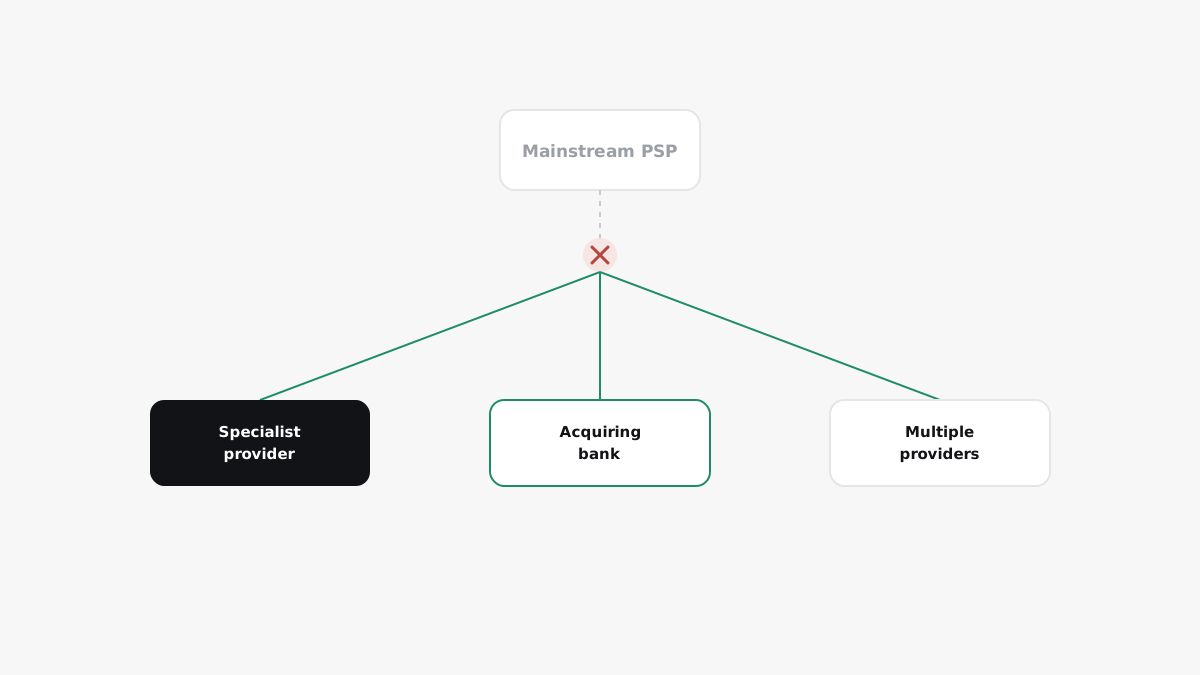
Stripe is excellent for many businesses. For pharmacies, supplement brands, CBD shops and medical cannabis, it's often not the right fit. Stripe generally doesn't support prescription medicine payments, restricts CBD and THC products, and prohibits some nutraceuticals. (We explain the detail in Can I use Stripe, Mollie or Shopify Payments for supplements, CBD or medicines?)
So what are the alternatives? This guide skips the "top 10" lists and explains the main types of option in Europe, who each one suits, and the questions that will save you from being shut down again.
First: what are you actually looking for?
Before comparing providers, be clear on three things:
- What exactly do you sell? List every product category, including the ones you think are "borderline".
- How do customers pay? Online only, in store, subscriptions, telemedicine partners?
- What went wrong before? Rejection, frozen funds, account closure, high fees?
Your answers decide which type of provider makes sense.
Option 1: Another mainstream provider
Examples: other well-known European checkout providers and wallets.
Good for: shops selling everyday vitamins and wellness products with careful, compliant wording.
Watch out for: most mainstream providers have similar restrictions to Stripe. Mollie, for example, doesn't accept pseudo-pharmaceuticals, unlicensed prescription medicine sales, or supplements that are harmful to consumer safety. You may get approved, but if your products sit anywhere near the edge of their rules, the same automated checks that caught you at Stripe can catch you again.
Verdict: fine for low-risk products. Risky if you were closed for what you sell.
Option 2: A specialist high-risk payment provider
What it is: a provider that openly approves businesses mainstream providers avoid, such as pharmacies, cannabis, supplements and subscriptions, and underwrites them properly from day one.
Good for: licensed pharmacies, medical cannabis, supplement brands with subscriptions, and anyone who's been closed before.
Watch out for: more documents at the start, possibly a rolling reserve (see Rolling reserves explained), and fees that can be higher than mainstream. Also, not all "high-risk" providers are equal. Some approve almost anyone and then close accounts just as quickly.
Verdict: usually the right choice if health products are your core business. Choose carefully.
Option 3: A direct merchant account with an acquiring bank
What it is: a contract directly with a bank that processes card payments (an acquirer), rather than through a platform.
Good for: larger, established pharmacies and brands with strong processing history.
Watch out for: longer onboarding, more technical setup, and banks that are often cautious about health categories. Many small businesses reach acquiring banks through a specialist provider instead.
Verdict: worth it at scale. Often too heavy for a small pharmacy doing its own ecommerce.
Option 4: More than one provider
What it is: instead of relying on one provider, your checkout connects to several. If one declines a payment or pauses your account, payments can go through another.
Good for: any high-risk business that can't afford for its checkout to stop, especially as volumes grow.
Watch out for: you need someone to manage the setup. Doing it yourself with multiple contracts is complicated, which is why this is often provided as a service.
Verdict: the best protection against shutdowns. Increasingly, the standard for serious health merchants.
Don't forget local payment methods
Whatever provider you choose, offering the right local methods helps:
- Cards everywhere
- iDEAL for Dutch customers. It's a direct bank payment and can't be charged back like a card
- Bank transfer and instant payments across the eurozone
- SEPA Direct Debit for German subscriptions, remembering customers can reverse it for up to eight weeks
Eight questions to ask any provider before signing
- "Do you currently approve businesses selling [my exact products]?" Look for a clear yes.
- "Can I get that approval in writing?"
- "Is there a reserve? What percentage, how long, and is it capped?"
- "What happens if my volume grows quickly?"
- "What dispute rate do you expect me to stay under?"
- "How much notice do you give before pausing or closing an account?"
- "Which payment methods can I offer with my products?" Wallets and buy-now-pay-later often have their own rules.
- "Who do I call when something goes wrong?" A named contact beats a ticket queue.
If a provider can't answer these clearly, keep looking.
This article is general information, not legal or financial advice. Provider policies change; always confirm directly with the provider before signing.